Patience is a practice mastered by found-footage aficionados.
Nicholas Pineda’s feature debut Infirmary, preceded only by his 2015 short Disquiet, will reward those who possess the endurance needed for this security cam-based slow burn. Edward (Paul Syre Lee) is reporting for duty as a security guard for the abandoned Wilshire Hospital. It is his first day, having hit the job market recently as an ex-marine with an injury. We also know, given the film’s framing as recovered footage part of an ongoing investigation, that it is his last day. Filmed entirely with bodycam and CCTV security camera footage, Infirmary sticks to the foundations of found footage and stays simplistic in its yellow-hued empty hallways and distorted slightly fish-eyed views. Pineda is smart to keep his cards to his chest, allowing tension to exponentially grow for a great final act payout.
Edward is meek, gullible, and rather unsure of himself. Luckily, he’s being led around his new domain by soon-to-be retired security officer Lester (Mark Anthony Williams), who is his foil in every way. Lester is a classic cut to the chase, “I’m getting too old for this shit,” type of grumpy guy who is quick to take advantage of shy little Ed. On the obligatory parameter tour, Lester is quick to give his new underling quite the scare, both physically with a good ol’ “lock you in the mortuary body storage drawer” prank, and emotionally with tales of the hospital's controversial history and whispers of haunted basements. The only other player the film offers is Ms. Downey (Danielle Kennedy), a nice but slightly off HR lady, meaning the hospital is quite truly empty. At least until an intruder is caught on the crew’s surveillance footage, that is, causing Edward and Lester to venture into the liminal depths of this medical labyrinth.
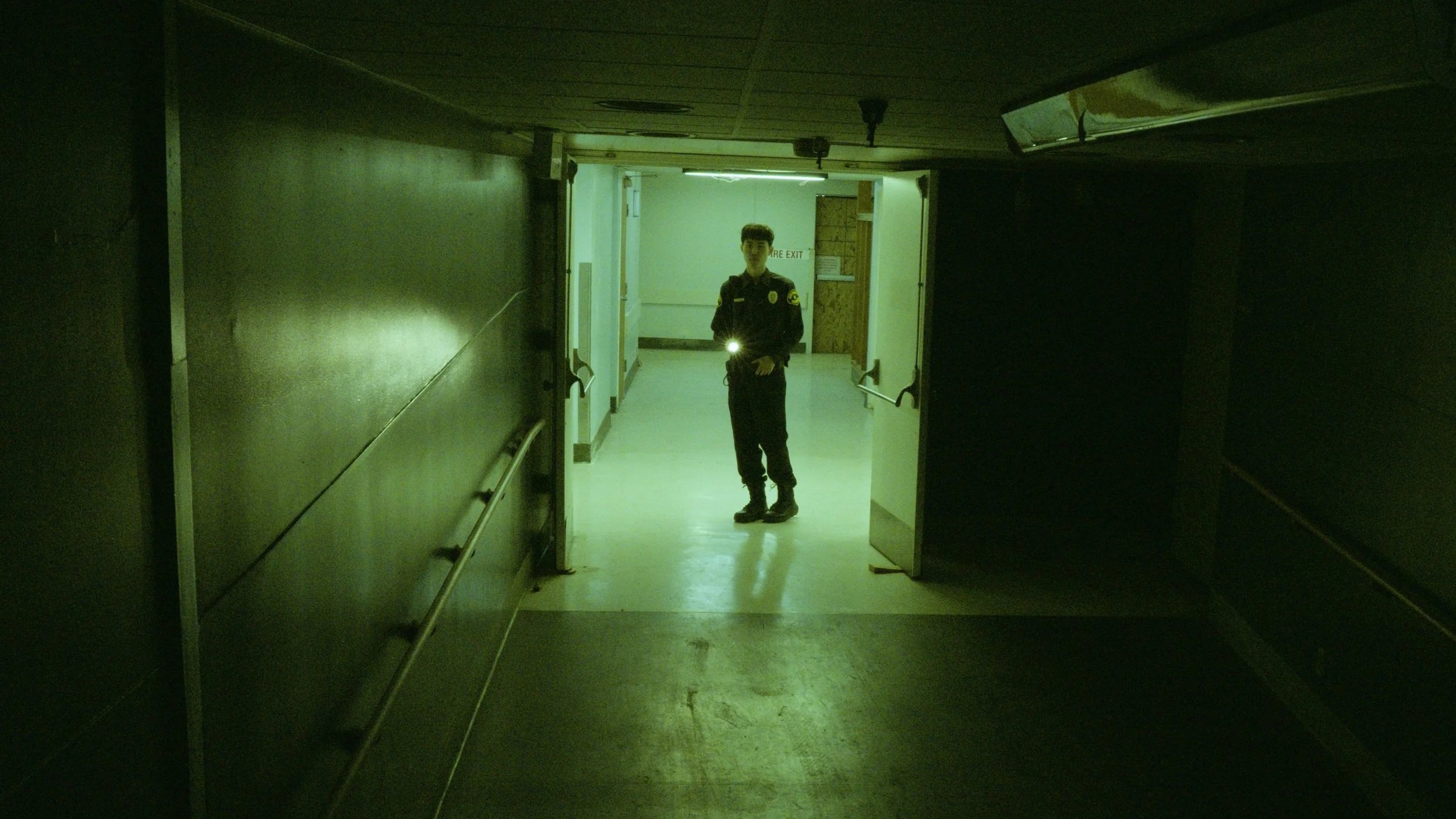
Paul Syre Lee as Edward in Infirmary. Photo courtesy of Shudder.
While Infirmary suffers from clunky and unnatural dialogue, we are not usually on the found-footage ride for its riveting scripts. The mastery of the genre’s technical execution is the name of the game. Pineda is deliberate in his direction, and cinematographer Donald Nam and editor Noah Kistler are able to carefully manage the images needed to ramp up the terror as we inch towards the end of the film's tight under-90-minute runtime. Switching between security camera wide angles that have you searching the frame, and close and personal bodycam footage that has you wondering what could be lingering just outside of view, Infirmary is a lesson in the ways less is truly more for found frights.
Just when you might find yourself tapping out, just as the film has held out on you for long enough, Infirmary takes such a given and almost obvious route that it is almost an unexpected turn. As an avid paranormal investigation consumer, mental hospitals and various medical wards are ripe with an unsettling energy perfect for activating a deeply subconscious dread. This film knows that there is no need to ramp the stakes beyond the confines of its setting. Darkness surrounding a disappointingly small circle of light from Ed’s flashlight, unused and outdated equipment, broken ceiling and floor tiles, the cynical nature of piles of medical records belonging to forgotten people, and out-of-place medical demonstration dummies are all that is needed.
Infirmary is a promising feature debut that proves that sticking to the basics is the key to creating a classic genre piece.
3.5/5